Showing posts with label Journey into Poetry Land. Show all posts

Sunday, April 13, 2014

FLASH BACK: Poetry Month Rewind- (Poetry Tool #1- Rhythm)

Greetings Friends!
I am back with another throw-back posting from last year's "Journey into Poetry Land".  I hope you enjoy reading (or re-reading) about this great lesson I taught my 4th, 5th, and 6th grade writing classes!
-Cheers,
Mr. Hughes


Poetry Tool #1- Rhythm

Welcome to Post #2 in a series of posts about my current journey teaching poetry to a group of 60 students composed of 4th, 5th, and 6th grade students. If you missed the intro post to this series, click HERE and check it out. It was posted on All Things Upper Elementary of which I am a contributor.

I was excited to start teaching the tools of poetry because that is where the students would get the chance to actually WRITE some poetry. I also planned to integrate our grammar study into this unit. Having tried to do a grammar lesson and then integrate it into the writing later was a total bust for me. I figured that I would have a longer block to to teach poetry AND it would be more authentic for my students. Turns out I was right!

We started by labeling the top of "the next clean page" in our journal (the next page after our listing of the difference of poetry and prose, and of the 6 tools) with "Tool #1- Rhythm". Student then wrote what they thought the definition of rhythm was . It was an interesting discussion. My musical students could show me examples with clapping and tapping, but couldn't really put it into words. After sharing several ideas, we decided that rhythm is comprised of beat and repetition.

First, for beat, I handed out rhythm sticks (thick dowels cut into thirds) to each student and (after explaining the expectations for use like "When I am talking, both sticks are in one hand", "No drumming on your desk or neighbor", etc.) then I asked them what was something that most people had around them every day that  has rhythm.

It was pretty quickly decided that MUSIC has rhythm. What I did next shocked them. I cranked the music and we practiced finding the rhythm of different genres of music. We played everything from county to heavy metal- (WHOA ON THE HEAVY METAL- more than I can take, I think). But they LOVED it. Whenever they struggled to find the beat of the song, I would have them close their eyes and listen before tapping. It was amazing how fast they were able to find it when they weren't distracted by their neighbors tapping.

After we jammed out for a bit, I  read several poems and had them tap the rhythm. I read some rhyming poems, but also many that were not rhyming because I wanted them to see that more than just rhyming poems have rhythm to them.

Then we studied what was meant by repetition. Both in beat AND in words. I read them the poem "Negro" to them and we discussed possible reasons that Langston Hughes would have repeated the words, "I am a Negro: Black as the night is black, Black like the depths of my Africa." at the end of the poem. I was surprised at their thoughts about this. Many picked up that he wanted to show that, despite the trials and problems his people had faced, they were still a proud people.


I then handed out all the poetry books again and had the students scavenger the pages looking for places where words were repeated. It was great fun to hear what they found and watch as they made connections between what we discussed to what they were reading.

For their homework, I gave them a poem called "Snowflake Souffle" by X. J. Kennedy . The students were to read it to a parent/family member and get it signed, underline common nouns, and circle proper nouns.

It was a wonderful end to a wonderful lesson. Don't miss Post #3 coming soon.

Cheers-
MrHughes

Monday, April 22, 2013

Journey into Poetry Land- The Final Post (Post #11)

Welcome back to my blog post series: Journey into Poetry Land. This is post #11 in the series. Post #1 is on the All Things Upper Elementary collaborative blog of which I am a contributor. Read it by clicking HERE. The rest are here on my own blog. Just search for "Journey into Poetry Land" on the left side in the search box! And now... on to post #11!

Greetings!
I must say that I have been bad about finishing this series, and I truly apologize for that. 
I will bring this series to a close in this post, so it will be a summary for the final days of this month long study.

After we studied cinquain, we also studied Haiku:

Limericks, Acrostic, and Shape Poems were the last three forms we covered. AND, sadly, I can NOT find a single one of my pictures for these different forms. We spent at least one day on each form, however, and the students were shown mentor text examples. Then I would model for the students how to write in that form and then they would write 2-3 of their own examples.

I LOVED IT! And more importantly, THEY loved it!

Then, as a break in the routine, I decided we were going to do a poetry graffiti wall. I took some large sheets of paper, held them to the brick wall in the hallway, and using a brown crayon, did a rubbing of the brick in several spots. It looked really cool and the kids enjoyed choosing their FAVORITE POEM from our study to add to the wall. I had 6 sheets of paper and had my 60 students each write their poem. There were some interesting poems, for sure. I have watched many students spend an entire recess standing in front of the poetry wall reading and laughing.


Before I started my final project, I noticed that my students needed a review of all the forms.
Because students were getting them mixed up and and weren't using their journals to help them (or didn't have complete notes), I created 6 stations- one for each poetry form we had covered. The students spent one entire class period rotating through them and simply writing poems. For each station, I had a outline of the form they were to practice and an example. Then we rotated every 10-12 minutes so they got to go through each station.


This was a MUCH NEEDED break from "learning" and an opportunity to "do" and "try". Many students expressed how nice it was to not worry about learning another form, but to simply practice, practice, practice what we had already covered!
Was it perfect? Of course not. Many students still struggled with the different forms, but it was nice to go from station to station to help them try to learn the form.


After all the review, the poetry graffiti wall, and stations, my students were ready for the final project and assessment of this 6 week study. I created the Poetry Anthology project for my kiddos to do.
It was over 20 pages for poems. They had to "collect" 10 mentor poems and write them in their anthology. Then they had to write 10 NEW poems (some assigned, some selected). They had to create a table of contents and they also had to have a sources page at the end. 

Can I just say WOW! I made a grading rubric that fit our school grading procedures and with the help of my team, we graded all 60 anthologies in less than two hours. I will TOTALLY do this unit again, but I will change up the forms and let them try out 6 NEW forms next year.

and THAT is what I call a successful journey into poetry land! YEE HAW!

I did end up creating a kit with all the major "stuff" from this unit. You can check it out HERE (or by clicking on the picture)


Cheers and Happy Teaching!
-Mr. Hughes


Sunday, March 17, 2013

Journey into Poetry Land- Form #2- Cinquain (Post #10)

Welcome back to my blog post series: Journey into Poetry Land. This is post #9 in the series. Post #1 is on the All Things Upper Elementary collaborative blog of which I am a contributor. Read it by clicking HERE. The rest are here on my own blog. Just search for "Journey into Poetry Land" on the left side in the search box! And now... on to post #10!


Cinquain- 
Funny story! When I originally planned this unit, I had written QUANTRAIN! But, when I made all the copies for my students, I discovered that I had copied CINQUAIN- Not this same thing- AT ALL!

So, I went with what I had copied. I am glad it worked out the way it did- after all everything happens for a reason. This form because one my students favorite.

Because I switched mid-stream to this form, I did NOT have a mentor text available. Hence, I modeled several attempts at this form or them, went over the guided instruction page, and drew out a scaffold template for them. Here are the student examples:


This next one is one of my absolute favorites from this class:

Cheeseburgers
Cooked Meat
Chewing, Swallowing, Smiling
Lettuce stacked onto Cheese
Heaven

While is doesn't maybe follow perfect form, this student caught on to the feeling that should go into poetry. LOVE IT!

Here you can see where the student drew out the template to follow.

This is an interesting example. I thought his made up word "Mathy" was hilarious. Most of the other words I have no idea what was said.


We spent most of the class time just writing lots of examples and sharing. We had a good time laughing and having fun. In fact, this turned out to be one of the favorite forms we studied in this unit. I loved teaching this form, even though it was very unexpected.

WAHOO! More coming soon. Thanks for reading and stop by again soon,

-Mr. Hughes

Monday, March 04, 2013

Tool #6: Rhyme and Form #1: Couplets (Post #9)

Welcome back to my blog post series: Journey into Poetry Land. This is post #9 in the series. Post #1 is on the All Things Upper Elementary collaborative blog of which I am a contributor. Read it by clicking HERE. The rest are here on my own blog. Just search for "Journey into Poetry Land" on the left side in the search box!
And now... on to post #9!


Wahoo! Can I tell you how excited I was when I realized that I was on my final "tools of poetry" lesson! I was getting anxious to move the students forward and into the forms of poetry where they would really get the "hands on" experience I was hoping to give them. Granted, as I reflected back over my lessons, I realized that I had done a good job of giving them good foundation of poetry. I also noticed, that I had provided many fun and interesting lessons along the way.

My lesson plan included a very brief review of rhyming words after which I would spend a majority of the time studying the first form: Couplets! Easy enough. After all, rhyming is a piece of cake for 4th, 5th, and 6th graders....right? right?!?! WRONG!

I was blown away by the number of students who could not rhyme AT ALL!  Let me back up a little. I had the students write "TOOL #6: RHYME" at the top of the next clean journal page. We wrote a definition (as seen from a screen shot of my SMART board file above). Then I listed a word and had them find more words that rhymed. The word "cat" seemed to go okay. They were doing well until I challenged them to find a rhyming word that was more than three letters long. It got so quiet you could hear crickets! I WAS ASTOUNDED! How could this be? After all, many of the students were good readers!

ARGH!

After spending nearly 30 minutes just discussing what makes a rhyme and rhyming words, I decided to start our expedition into Couplets. I reasoned that they would still be practicing rhyming, and it would be in context and might make more sense.

So, next clean page, "FORM #1: COUPLETS" written at the top. We defined the form in their journals- two lines, same number of syllables (for which we had to stop and practice those as well- YIKES!!! How could these students not have these basic skills down????) and the last words rhyme. So, an AA pattern.

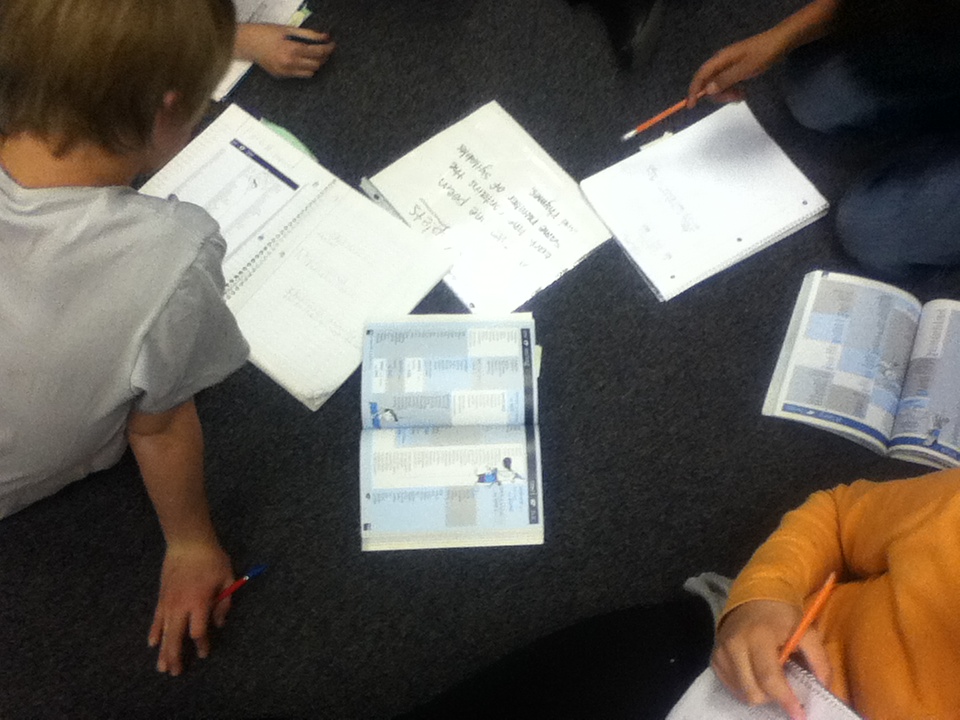
I read them several examples of couplets from our mentor texts and then I gave them a copy of a page from Scholastic's Rhyming Dictionary (which by the way is a total GEM for any writing classroom! I currently have 4 copies and think I will be investing in several more before next year's poetry unit.) I then told them to use the list of words (thinking this would help) and write a poem. I even handed out a form that walked them step-by-step through the process. They were stumped. frozen. Baffled.

Pause the scene- have you had these days??? The days where you begin to think that you are NOT a very good teacher? Well, this day was one of the worst. I was totally stumped as to why they were confused.

Resume scene:
I stopped the class and read several more mentor text examples. I then started a poem on the board for us to do together (should have done this BEFORE pushing them "out of the nest". I gave them the line, "I bought a bike, I was brand new".

We counted the syllables- 8. So, I challenged them to write a second sentence that would continue the thought, have 8 syllables, and rhyme with "new". Granted that is a pretty big request, but I had them working with partners and as a whole class. I knew I was in trouble when a student offered this as the final line, "And rode it down the street!". He was so proud of himself, and I was beyond done for the day. Ha ha.

I finished the line for them: "And rode it down the avenue.".

The room filled with Ohhhhh's. I know that it sounds like am exaggerating, but I promise that not more than 20 of my 60 students really did (or still does) have a good grasp on rhyming. I think my first mistake was giving them a list of rhyming words, and my second was... well, moving on before we had rhyming down.

I knew that this would be a 2-day lesson. And it was. On the second day, we simply viewed more mentor texts and practiced and practiced writing couplets. After the 2-day adventure, I felt a little better about couplets. I was so frazzled, I didn't even take any pictures of student samples to show you. Sigh...

The student's homework for day 1 was a collection of Haiku poems, and day 2 was The Village Blacksmith (the one I had used for my lesson on Sensory Imagery).

Well, thankfully it got better from here (at least for a couple of forms). So...
Until my next post on poetry-
Cheers!
Mr. Hughes

Sunday, March 03, 2013

Tool #5: Shape and Form (Post #8)

Welcome back to my blog post series: Journey into Poetry Land. This is post #8 in the series. Post #1 is on All Things Upper Elementary of which I am a contributor. Read it by clicking HERE. The rest are here on my own blog.


I knew because of my desire to focus on 6 main types of poetry, that I would not be spending too much time on this tool at this lesson. We took one full lesson and made notations about each of the 6 forms of poetry that I was going to focus on and then we discussed "shape".

When I asked my students about "shape" the rattled off a bunch of geometric shapes.I knew that this wouldn't be as easy as it seemed, but, I also realized that I didn't really expect them to know much about it either. But, I had a plan!

I pulled out many different examples from my mentor texts and put various pages under the document camera. As a class we talked about the "white space" on the page, and guessed at why the author had made the decision to break a line where he/she did.

This was a very eye opening experience for my kiddos. Most had not stopped to think how breaking a line at different spot could affect the flow, the meaning, or the tone of the poem.

After looking at many examples from mentor texts, we looked back over our own examples that we had been writing in our journals and shared with our neighbors what we had written and why.

So, even though there is not a lot of eye-candy on this page to share with you, I would strongly encourage you to ensure the students get the opportunity to look at and discuss how "white space" affects poetry.

Happy Teaching!
-Mr. Hughes

Tomorrow will be the final post on the tools of poetry. Then I will address how I taught the 6 forms I shared with my class. Then I will finish up this series with explaining my Poetry Anthology project and how I graded all 60 sets of 20 pages- WOW!. So stay tuned for the grand finale coming in the next couple of weeks.

Sunday, February 24, 2013

Tool #4: Comparisons (Post #7)

Welcome back to my blog post series: Journey into Poetry Land. This is post #7 in the series. Post #1 is on All Things Upper Elementary of which I am a contributor. Read it by clicking HERE. The rest are here on my own blog.

Tool number four was going to be a challenge for me to teach. The concepts that I needed to really get across was similes and metaphors. I really wanted to do something to get their attention so I came up with a plan.


I started each of my three class sessions by asking the students what "Compare" meant. I was surprised at the lack of understanding in this department. I had then had the students draw a t-chart and compare summer and winter. We talked about what was the same and what was different.

Then, I showed them the following video:


After they finished laughing and talking about what they saw, I asked them what was being compared. They compared all sorts of things, but not what was really being compared... the happiness of the customer to the happiness of the witch.

I saw doubt on their faces. So we watched another one. I told them to watch carefully and LISTEN to what the two guitar men at the end said to each other. I started the next video:


After it was over, they immediately caught on what was being prepared. We talked about it for a minute or two (focusing on the KEY WORDS that show comparisons) and then I showed them one final video (I saved this one until the end because it is my favorite one!).


Ha ha! Isn't that one AWESOME! We again discussed the comparisons being made. I had the students make notes in their writing journals about what they had learned from the lesson.

I then handed out a copy of a packet from a book that I have at school, Figuratively Speaking by Creative Teaching. It has wonderful 3-4 page packets that focus on the specific skills. Part of the packet asks the students to write a poem using provided prompts that compares a life event to something else. This is what I wrote as the model poem. I compared accomplishment to going on a hike


Accomplishment
Accomplishment is like a hike.
You set your sights on the top like a dog does a bone.
You start off, usually like a shot out of a gun,
Sometimes you stumble like a wounded deer.
But, when you reach the top, your heart races like a NASCAR engine,
and you cheer like you just won a million dollars!

After I modeled my poem, I challenged them to write one of their own. That is how we spent the remainder of the class period. 

Before they left, I made sure they had written in their journals:

=Similes
Compare two unlike things, usually using LIKE or AS (or THAN, like in the commercials)

=Metaphors (More difficult)
Compare two unlike things with OUT using LIKE or AS (usually 'was')


For their homework, I assigned them: The Runner by Walt Whitman. They had to find the common and proper nouns, find alliteration, onomatopoeia, imagery words, and any simile or metaphors.  

YES! Another successful lesson taught! MAN, I love teaching writing... sigh...

Until next time-
Cheers!
-Mr. Hughes

P.S. I wanted to share that I am the featured teacher in the Teachers Pay Teachers Newsletter today. WAHOO! When I can find the link to the on-line version, I will link it here. :)

I also wanted to let everyone know that I have finished my Poetry Unit (that has some of what I have been sharing here) in my store now! Check it out by clicking the picture below:

Saturday, February 09, 2013

Poetry Tool #3: Sensory Imagery (Post #6)

Welcome back to my blog post series: Journey into Poetry Land. This is post #6 in the series. Post #1 is on All Things Upper Elementary of which I am a contributor. Read it by clicking HERE. The rest are here on my own blog. And with THAT disclaimer, on with the post.

With the four parts of Tool #2 addressed (we won't say mastered, but time will fix that!), I was excited to move on to Tool #3- Sensory Imagery. 

I had the students start by opening their journals and turn to the next clean page. They wrote "TOOL #3- SENSORY IMAGERY" at the top. I then had them list what they thought the 5 senses were. I got some pretty funny answers,. like "color". 

After we all agreed on what the five senses are, I told them that we were going to do a writing experiment with food. That caught their attention. They had never heard about a writing experiment and I rarely let them have food in my class. 

FLASHBACK: I had planned to buy a decent treat for each student- like mini-candy bars. However, aside from forgetting until the day of my lesson, I have two diabetic students and didn't want to deal with shots and monitors due to my lesson. So, I dug around in my "stash" and found a bunch of packages of mini-gummi worms and bears. Just enough to do the writing project, but not too much to get them all hyper. So, when I do this again, I will use the exact same size candy/treats.


I handed out a work mat to each student and explained what they were to do. I told them to pretend that this was the last piece of candy they would ever get to eat and write about each sense so that they would always remember the different senses about it. I had them close their eyes and hold out their hands. I put one piece in each child's hand. They were to discover the "touch" sense with their eyes closed so they could really focus on what they had in their hand. Once they felt they could describe it, they opened their eyes and went to work silently recording all the other 5 senses about their candy. I gave them about 5 minutes to work after which time they shared with their partners and discussed words and phrases they used.


The kids were all excited about being able to eat and talk about candy. Next, I read them the poem, The Village Blacksmith by Henry Wadsworth Longfellow and I had them draw a picture of what they saw in their minds as they listened to the poem. I was amazed at the level of detail some kids picked up that related to sounds and smells they would have smelled.

This activity was my bridge to the final activity of the lesson. I have collected old calendars for years so I could have the scenic pictures from them. I have used this pictures for art lessons, writing lessons, and today it was for sensory lessons. I put a picture under the document camera and asked students to study the picture and give me a "sight" sense from the picture. We talked about the colors, etc.

Then, I asked for a "hearing" sense word. They looked at me for a minute and then a student blurted out "tweeting". We all laughed, I reminded them to raise their hands, and then we discussed that that was a correct answer. Some students struggled to "imagine" what they would smell, feel, hear, and taste if they were standing in that spot. Many were adamant that they would NOT lick rocks, trees, or animals, and therefore could not fill out the taste column of their work mat. I stopped the class and we discussed how smell and taste work in tandem and that sometimes what we smell outside, we can almost taste. This seemed to help them feel better about writing what things might "taste" like.

Here are a few pictures of students working with various pictures. Each student had their OWN picture, but I think when I do this again, I will have the students work in pairs- they will write silently for 5 minutes and then work together for 5 minutes or so. I think they will be more productive that way.


I reminded the students to write LOTS of details because class was ending and I would be gathering back up the pictures and they would do a writing assignment with their work mats the next day WITHOUT getting the pictures back. ha ha. That got them focused on writing.

As class ended, students returned the pictures to me and put their work mats in their desks. We reviewed what we had covered for the day, I handed out the poem, The Brook as homework and sent them on their way.

Wahoo! Another successful lesson taught. This one has been one of my favorites thus far in this unit. In the next post I will explain what they did with their work mats, and more about the next poetry tool.

Cheers!
-Mr. Hughes


Saturday, February 02, 2013

Tool #2- Part D- Vigorous Verbs

Welcome back to Post #5 in my Journey into Poetry Land series. To read all the posts in the this series, click HERE to see all the posts from this blog. My first posting was on All Things Upper Elementary, of which I am a contributor. The rest of the posts are located here, on An Educator's Life.

I am going to skip my Monday lesson as it was a noun review of common and proper nouns. My kiddos were NOT getting nouns. However, I did post about it over at All Things Upper Elementary if you want to read about that lesson. For the actual lesson, click HERE.

Tuesday, we started and finished Part D of Tool #2. Vigorous Verbs. I LOVED this lesson.

We started by correcting their homework from the previous day. It was the "Full Fathom Five" by Shakespeare. It is a short, but powerful poem full of alliteration, beat, rhythm, nouns, and I believe some onomatopoeia. 

Then, we turned to the "next clean page" in our journal and wrote: Tool #2-Part D- Vigorous Verbs.
I then asked the kids to write a definition for "verb" and for "vigorous". You can see an example in the pictures below. After letting them share their guesses, and before I told them the answers, we did a little activity.

We read a poem together. The Turkey Shot Out of the Oven  by Jack Prelutsky. What a fantastic poem for strong verb usage, not to mention the kids think it is totally hilarious.
We talked about which words are STRONG verbs, and I would challenge them to give me "weak" verbs to replace the strong verbs so they could hear the difference.

We talked about how -ing verbs are strong verbs. Even in the Turkey poem, "ing" verbs were galore! I then told them that they were going to write a verb poem that was weather related. They raised their eyebrows at me. I am starting to feel that I am not a great teacher of poetry...ha ha. I get looks of confusion a lot during these lessons.

I knew that they would need me to model, so I showed them the process I went through to write my own "ing" poem. I showed them a poem that I had written as an example for them:

Listening, light fading, the day quaking.
Whispering, reaching, touching it comes.
Nearer, Nearer we hear,
Screaming over the hills and down into the light-less valleys.
Grasping, tearing, pulling what is not held firm to the earth,
Howling, whining, fading, departing,
Leaving trees shivering and houses sighing.
The wind.
-Mr. Hughes January, 2013

I don't know that it was much help, other than I was able to underline all the "ing" words for them. I had them get started and worked with smaller groups to make it more clear to them. Here are several student samples that were written:


We ended the class by sharing a few of the poems that had been written. It was great. I was beginning to feel that maybe they WERE understanding just a little bit. If nothing else, many students have commented that they now like poetry and it is not what they thought it would be.

For homework, the students were assigned the poem, Listen to the Rain by Bill Martin. Such a powerful poem for strong verbs, and all the other "goodies" we had been discussing. And, I had a surprise ready for them the next day that went along with their poem.

Cheers!
-Mr. Hughes

Thursday, January 31, 2013

Poetry Tool #2- Part C Alliteration

Greetings!
It has been FAR too long since I have posted on my poetry lessons, and now I am two weeks behind in posts. So I will try my best to blog over the next several days and catch everyone up.

We ended Post #3 at the middle of my Alliteration lesson. I had run out of time to really finish the lesson and so I simply had them read poetry books to find examples, which was part of the lesson, for a long amount of time. I found that I was in such a rush to "get through" the lesson, that I was leaving comprehension in the dust.

When they returned for the next class period, we started by correcting their homework, which was Lewis Carrolls, Jabberwocky.  I found that many of the students had a hard time because the poem has so many invented words (Tool #2, Part B) that they couldn't really make sense of the words. It was fun to hear what they thought some of the words were as well. This did take a large chunk of time, but I felt it was totally worth it because we were reviewing SO MANY concepts.

After we corrected homework together (I had a copy of the poem under the document camera), I reviewed what we had already covered about differences in poetry and prose, Tool #1 (Rhythm), and Parts A, B, and C of Tool #2 (Musical Language).


I was excited to have them pick up where we left of the day before and get them writing alliterative phrases/poem. I stuck with more of the tongue twister genre for this writing assignment because I REALLY wanted my students to HEAR the alliterative sounds. 

I instructed them to take the first letter and SOUND from their first name and try writing a sentence using that SOUND as much as possible. At first they didn't understand it too well. So I gave many examples using student's names.

Morgan makes mega muffins every morning. 

Rad wrestles really rowdy road-runners.

It only took a couple before the kids were having a ball. It really was fun when they picked up that the words the to SOUND the same, NOT start with the same letters!

Here are a couple of student examples:


I let them write for about 10 minutes and then I had them share their two favorites with their partners before drawing names and having 4 students read to the class.

I was really impressed with how well they did. I knew that this would become part of the "hunt"activities for the nightly poem and I was confident that they would master it over time.

For their homework, they read a poem called Chuck's Chips. It is in the Tongue Twister book I shared in my last post. The students had to identify the alliterative phrases in the poem (and there was a lot!) as well as all the other "hunts" I assigned.


Thanks for reading post #4 in this series. If you missed the first post, you may want to start HERE and catch up. :) If not, that's okay too. I am just so pleased that you are here. Don't forget to follow my blog to get all the latest news, updates, and more. 

Cheers!
-MrHughes

Thursday, January 24, 2013

Poetry Tool #2- Musical Language- Part B- Invented Words (and a start on Part C- Alliteration)

Dr. Seuss is such an amazing writer. He ability to bend the rules of writing and poetry astound me. He was the perfect name to bring up as I introduced Part B of Musical Language to my students. 

INVENTED WORDS!

I had a hands-on lesson planned for this tool. After we talked about Dr. Seuss for a bit, I started by having the students listen to a story by Jon Scieszka and Lane Smith called Baloney. If you haven't ever read this book you need to! It is such a perfect example of invented words. It is about a little alien that is late to school and has to give an excuse as to why. So, he makes up a HUGE story and invents words to describe many of the items he uses and encounters. 

My students LOVED it! Then, it is fun to tell them that almost all of the "made up"words are actually REAL words from several languages around the world.


After I read them the book, I told them they were going to list 10 words for those 10 items around the room and then make up a new word for that item. 

I modeled for them so they could see what they were supposed to do.
I chose:
desk
chair
teacher
clock
pencil

I renamed them:
desk=sked
chair=popsquat
teacher=talkity-talk
clock=tell-timer
pencil=higrate

The kids just raised their eyebrows at me. Undaunted, I proceeded to explain to them that they were going to use these words in a poem. Then I used those words to write a free verse poem as a model. This is what I wrote:

The Classroom
I was sitting on my popsquat
Watching the tell-timer tell time.

My talkity-talk was going on and on
While I watched the tell-timer tell time.

My higrate was tapping on my sked, not writing my notes
While I watched the tell-timer tell time.

But, when my talkity-talk tapped on by sked,
I knew my time-teller watching must end.

I was very pleased with myself. I turned to see uncertainty on their faces. I laughed at them and told them to get started on their own list and poems. I was actually quite impressed with what my students were able to create. 

A few students got stuck on how to rename things. I told them that an easy strategy was one that I had used. I asked them to look at my first word and the new word I had made. They pointed out that I had just mixed up the letters of the "real" word. The light clicked on above their heads and they were able to move forward and finish their lists and start their poems. 

It was hilarious to see what they came up with. After they finished making the "new word"list and writing their poems I had several students share with the class using the document camera. Below are a couple of examples.


For the second part of class, I wanted to get a start on Part C as well!

Part C is also one of my favorite tools to teach. How lucky for me that I teach all my favorite tools...ha ha. I wonder how THAT happened.

Anyways, Part C is Alliteration. The students had heard the word, but couldn't place it's meaning. I said, "Let me share an example of an alliteration with you!" They sat and watched me expectantly. I think they thought I was going to do a back-flip or something. I just stared at them for a moment. They started to get all fidgety like they were in trouble. Then I blurted out, "Betty Boughta, bought some butter, but she said, "This butters bitter, if I put it in my batter it will make my batter bitter."

They looked at each other, and then at me and all together said, "What did you just say?".
I laughed and repeated it.

I then shared Peter Piper picked a peck of pickled peppers with them. Someone finally shouted, "OH, alliteration means tongue twisters!"

Well, that isn't really what I was hoping for, but it was a start. I guided the discussion to help them understand that alliteration is about the BEGINNING sounds of words. I shared a few more examples out of this book:


I didn't link it because it is out of print and very costly right now.
Then I handed out my trusty poetry books and the students went on an Alliteration Hunt. When they found an example, they raised their hands and shared with the class.

It was fun to watch them discover that alliteration is found in short groups, in phrases, and in entire poems.

The poetry hunt brought us to the end of the class time. I was sad as I hadn't quite finished my planned lesson, but I knew I could add it on to the beginning of the next day.

Their homework assignment for the night was "Jabberwocky" by Lewis Carroll. The students were to underline the common nouns, circle the proper nouns, and then choose one of the stanzas and try and guess what the invented words that Lewis Carroll had invented were supposed to mean.

Thanks for reading post #3 in this series. If you missed the first post, you may want to start HERE and catch up. :) If not, that's okay too. I am just so pleased that you are here. Don't forget to follow my blog to get all the latest news, updates, and more. 

Cheers!
-MrHughes

Tuesday, January 22, 2013

Poetry Tool #2- Musical Language- Part A


Welcome back to Post #3 in this series of Poetry Lessons in my classroom. If you missed the first post, you may want to start HERE and then catch up. If not, well, that's okay too. :)


     The first week of the unit was spent introducing poetry, reading LOTS of poetry books together and individually, and doing "poetry hunts". I only have all my classes four days a week. We have 1/2 day Friday every week, and so I only keep my homeroom class (my 6th graders) on that day. So I am teaching poetry 4 days a week right now. Thursday of the previous week was when we really hit Tool #1- Rhythm and Repetition. I actually spread that over two days as I was looking at my lesson plans. We spent a lot of time practicing and reviewing.

Monday of this last week, I started on Tool #2 and I had, what I hoped was, an amazing game plan. I would Use this format (This is from my on-line plan book):

Mini-Lesson:
-Correct Homework
-Review Tools- 
=Rhythm: Repetition and Beat
-Write a poem that has rhythm and repetition about winter
Do one together
---Snow is falling, falling, falling
---Drifting, drifting, drifting down
---Kids are laughing, sledding, building snowmen
---Kids are falling, crashing, creating snow angels.

Start Tool #2: MUSICAL LANGUAGE (WORD CHOICE)
--Onomatopoeia
=Students write a definition in their journals: Words that sound like the actions or sounds they represent
==Onomatopoeia Brainstorm sheet list as many as possible on each line. Work with your partner. (3-5 minutes)
==Share with class (call on several students)
==WILL CONTINUE ON TOMORROW

--Practice Porch Light Poem
--If you still have time, hand out the homework, read over the poem and discuss

HW: Youth, I Do Adore Thee! Underline the COMMON NOUNS.


I decided that to really ingrain it in their brains, I needed to do a review the next day and then assign a poem that would allow for practice of the previous days topic. We reviewed the Snowflake Souffle poem, read it together, in a round (works PERFECTLY for that), and then we talked about where all the nouns were located. I still find it troubling that some many of my students- all grades- can not identify a noun, I will be making a nouns review game/activity soon to help with that.

After we reviewed the homework poem, we reviewed how Tool #1- Rhythm (beat and repetition) is vital to poetry. Then, I modeled a poem for them that included repetition  I am FAR, FAR from a poet, but it was fun to share an example with the class. 

Mine was this:

Snow is falling, falling, falling
Drifting, drifting, drifting down
Kids are laughing, sledding, building snowmen
Kids are falling, crashing, creating snow angels.


As a class we decided that the ending of the last two lines didn't quite work with the rhythm and beat. We took off "snowmen" and "snow angles" and that seemed to help. So we decided on this:

Snow is falling, falling, falling
Drifting, drifting, drifting down
Kids are laughing, sledding, building
Kids are falling, crashing, creating.

Then I asked the students to write a poem with rhythm and beat about winter. I thought some of them were going to have a heart-attack. But, after I quieted the terror and whining, they settled down and started to write.  Here a few of the students poems:


 I had several students share their work with the class and show it under the document camera. We were able to talk about poetic form, etc. It was a great discussion tool and many students found that they had an inner poet they didn't know existed. 

This sample below is from a student who was VERY hesitant and resistant to trying. I coaxed and cheered until the student finally gave it a try. I think the results are amazing. This student even used a tool we hadn't really addressed yet- onomatopoeia. An avid hunter, this student wrote about something he/she could relate to: Duck Hunting!


So, after we had a good share time, we moved on to Tool #2- Musical Language. I tied this to the 6-traits of writing's Word Choice trait. 


Students wrote this on the "next clean page" in their journals and we proceeded. 

I was excited to teach Part A of this tool. It has three parts that will be separate posts. Part A is Onomatopoeia This is such a FUN, FUN tool of any writing, not just poetry. Thankfully, The Write Genre book had some fun ideas, but a majority of my lesson came from a unit I had purchased on Teachers Pay Teachers by the Peanut Gallery. Teaching Onomatopoeia: Creative Activities for the Classroom (Common Core) is totally worth the $$$! Regardless of what you use, you will want to do many activities to get the kids excited. This lesson by FAR had the most participation. The kids loved making all the "sound effects" that came with the activities. We used one of the pages from the above kit as part of their homework, Onomatopoeia Brainstorm. The students were put in groups for a few minutes to get started, and then they were to finish at home. I told them they would want to finish their assignment because they would need it for tomorrow's poem writing.

We again ended by getting out all the poetry books and  searching and searching for examples. The kids LOVED sharing the little snippets they found.

As class ended, I went over their assigned homework poem. I choose, "Youth, I Do Adore Thee!" from William Shakespeare. The students thought it was a odd choice, but the strange rhythm and the obvious repetition made it an easy choice. 

And so ended another success class session about poetry. 

WAHOO! I am LOVING this unit.

Check back soon for the next post in the series. I will be sharing my lesson Tool #2- Musical Language Part B- Invented Words.

Cheers!
-MrHughes


You Might Also Like Reading These:

Related Posts Plugin for WordPress, Blogger...

ShareThis